
ChatGPT Custom Instructions Template: A Comprehensive Guide (Updated 04/09/2026)
Today, with 100 million weekly users, ChatGPT’s evolution includes powerful CLI tools, conversation memory, and a burgeoning ChatGPT Store,
making custom instructions vital for personalized AI experiences.
ChatGPT’s capabilities have rapidly expanded, moving beyond simple chatbot interactions to become a versatile tool for content creation, code generation, and data analysis. A key component in harnessing this power lies in ChatGPT Custom Instructions, a feature introduced a few months ago by OpenAI. These instructions allow users to tailor ChatGPT’s responses to their specific needs and preferences, effectively transforming it from a generic AI into a personalized assistant.
This guide provides a comprehensive overview of custom instructions, covering everything from defining your expertise and preferred communication style to advanced techniques like persona-based prompting and iterative refinement. We’ll explore how to avoid common pitfalls, optimize instructions for specific use cases, and address crucial security and ethical considerations, including prompt injection and bias. The recent addition of conversation memory further enhances the value of well-crafted custom instructions, ensuring a more consistent and relevant experience.
What are ChatGPT Custom Instructions?
ChatGPT Custom Instructions are essentially pre-defined guidelines you provide to the AI, shaping its responses without needing to repeat them in every conversation. Unlike prompts which are specific to each interaction, custom instructions act as a persistent background context. They tell ChatGPT how you want it to respond, rather than what to respond to.
Think of them as setting the stage for every conversation. You can define your expertise – are you a seasoned developer or a marketing novice? – and specify your preferred tone and style. This feature, launched by OpenAI, allows for a more refined and personalized experience, moving away from generic AI outputs. Effectively, they unlock a way to make ChatGPT feel less like a general tool and more like a dedicated assistant who understands your unique requirements, improving results and saving time.
Why Use a Custom Instructions Template?
Employing a Custom Instructions Template is crucial for maximizing ChatGPT’s potential, especially with its growing user base of 100 million weekly users. Without them, you risk receiving generic responses that require constant refinement. A template ensures consistency and saves valuable time by eliminating repetitive prompting.
Forbes contributors highlight that often, suboptimal results stem from neglecting this feature. Templates help avoid common mistakes and optimize ChatGPT for specific use cases. They’re particularly beneficial as OpenAI enhances ChatGPT with features like conversation memory and the ChatGPT Store, demanding more nuanced control. Furthermore, a well-defined template can mitigate bias and even help safeguard against prompt injection attacks, ensuring more reliable and secure interactions with this powerful AI tool.
Building Your ChatGPT Custom Instructions Template
Crafting effective instructions involves defining your role, expertise, and preferred communication style, laying the groundwork for tailored interactions with ChatGPT and its evolving features.
Section 1: Personal Background & Role
Establishing a clear persona within your custom instructions is paramount. Begin by detailing your professional background – are you a seasoned marketing professional, a budding software engineer, or a curious researcher? Specify your areas of expertise; this helps ChatGPT understand the context of your requests. Don’t hesitate to outline your interests, as this can subtly influence the tone and relevance of responses.
Furthermore, define your ‘role’ in the interaction. Are you the client, the editor, the student, or the mentor? This framing guides ChatGPT’s behavior. For example, instructing ChatGPT to “act as my marketing assistant” immediately sets expectations for its responses. Remember, the more detailed your background and role definition, the more effectively ChatGPT can tailor its output to your specific needs, leveraging its 100 million weekly users’ collective experience.
Consider how you want ChatGPT to perceive your level of knowledge. Are you a beginner seeking explanations, or an expert requiring concise summaries?
Defining Your Expertise & Interests
Precisely articulating your expertise is crucial for optimal ChatGPT performance. Detail your skills – are you proficient in Python, SEO, or historical analysis? Specify your knowledge level (beginner, intermediate, expert) within each area. This allows ChatGPT to adjust the complexity of its responses accordingly, avoiding overly simplistic or needlessly technical explanations.
Beyond skills, outline your interests. Do you focus on sustainable technology, vintage fashion, or astrophysics? Mentioning these preferences guides ChatGPT towards more relevant and engaging content. This is especially valuable given ChatGPT’s broad knowledge base and 100 million weekly users.
Consider including specific domains you avoid. For instance, “I have no interest in sports or celebrity gossip.” This prevents ChatGPT from introducing irrelevant information. A well-defined expertise and interest profile transforms ChatGPT from a generic chatbot into a personalized assistant, enhancing its utility and aligning it with your unique needs.
Specifying Your Preferred Communication Style
Clearly defining your desired communication style dramatically improves ChatGPT’s output. Do you prefer concise, bullet-point summaries or detailed, narrative explanations? Indicate your preferred tone – formal, informal, humorous, or technical. Specify if you require responses to be geared towards a particular audience, such as experts or novices.

Mention your preferred length for responses. Do you want brief answers or comprehensive analyses? Request a specific writing style, like “write as if you are a seasoned journalist” or “explain this concept as you would to a child.” Given ChatGPT’s widespread use by founders and its 100 million weekly users, tailoring the style is key.
Don’t hesitate to request specific formatting preferences, like the inclusion of headings, lists, or code blocks. A well-defined communication style ensures ChatGPT consistently delivers information in a manner that is both understandable and aligned with your individual preferences, maximizing efficiency and satisfaction.
Section 2: Task-Specific Instructions
This section focuses on tailoring ChatGPT’s behavior for specific tasks. Detail your expectations for content creation – desired length, target audience, keywords, and style. For code generation, specify the programming language, required libraries, and desired level of commenting. When requesting data analysis, clearly define the data source, the type of analysis needed, and the desired output format.
Be precise. Instead of “summarize this article,” try “provide a three-paragraph summary of this article, focusing on the key arguments and supporting evidence.” With the rise of the ChatGPT Store and its potential for specialized AI applications, task-specific instructions become crucial.
Remember that ChatGPT’s ability to remember things is improving with new conversation memory features. Leverage this by building upon previous instructions and refining your requests iteratively for optimal results.
Instructions for Content Creation (e.g., blog posts, articles)
For blog posts and articles, instruct ChatGPT on the desired tone – formal, informal, humorous, or technical. Specify the target audience’s knowledge level to ensure appropriate complexity. Define the article’s purpose: is it to inform, persuade, or entertain? Request specific formatting, such as headings, subheadings, bullet points, and image suggestions.
Include keyword guidance for SEO optimization. If you’re a founder leveraging ChatGPT for personal branding, instruct it to maintain a consistent voice aligned with your established brand identity. With 100 million weekly users, standing out requires well-crafted content.
Consider requesting outlines before full drafts to ensure alignment with your vision. Remember, iterative refinement of instructions, aided by ChatGPT’s evolving memory, yields superior results.
Instructions for Code Generation & Debugging
When requesting code, clearly specify the programming language, desired functionality, and any specific libraries or frameworks to utilize. Instruct ChatGPT to prioritize code clarity and include comments explaining complex logic. For debugging, provide the code snippet and the error message, requesting a step-by-step explanation of the issue and a corrected version.
Specify preferred coding style guidelines (e.g., PEP 8 for Python). If using ChatGPT via the CLI, ensure the chosen provider supports the necessary language and features. Given the potential for prompt injection, carefully review generated code for security vulnerabilities.
Request unit tests to verify code functionality. Remember, ChatGPT’s capabilities are constantly evolving, so iterative refinement of instructions is key to achieving optimal results.
Instructions for Data Analysis & Summarization
When providing data, clearly define the format (e.g., CSV, JSON) and the desired analysis type – descriptive statistics, trend identification, or comparative analysis. Specify the level of detail required in the summarization; concise bullet points or a comprehensive report. Instruct ChatGPT to highlight key insights and potential anomalies within the data.
If using the ChatGPT CLI, confirm the chosen LLM can handle the data volume and complexity. Be mindful of potential biases in the data and request ChatGPT to acknowledge these limitations in its analysis. Given the chatbot’s memory limitations, break down large datasets into manageable chunks.
Request visualizations (if possible) to aid understanding; Remember, ChatGPT can be tricked by hidden text, so ensure data integrity.
Advanced Techniques for Custom Instructions
Refine instructions iteratively, leveraging persona-based prompts and understanding ChatGPT’s evolving capabilities, including conversation memory, to unlock more nuanced and effective AI interactions.
Using Persona-Based Instructions

Crafting instructions that define a specific persona for ChatGPT can dramatically improve the relevance and quality of its responses. Instead of simply asking for information, instruct ChatGPT to be a particular expert – a seasoned marketing consultant, a meticulous legal professional, or even a creative writing instructor.
This approach moves beyond basic prompting, enabling ChatGPT to adopt a consistent tone, vocabulary, and perspective aligned with the designated role. For example, you could instruct it to “Respond as if you are Dr. Lance B. Eliot, a world-renowned AI scientist, providing insightful analysis.”
The key is detailed characterization. Specify not only the profession but also the individual’s experience level, communication style, and even potential biases. This allows ChatGPT to generate outputs that feel less generic and more tailored to your specific needs, mirroring the expertise of a real person. Experiment with different personas to discover which yields the most valuable results for your tasks.
Implementing Iterative Refinement of Instructions
Custom instructions aren’t a “set it and forget it” feature; they require ongoing refinement to achieve optimal performance. Begin with a foundational set of instructions, then systematically test and evaluate the results. If ChatGPT’s responses aren’t aligned with your expectations, don’t hesitate to adjust your instructions.
This iterative process involves making small, incremental changes – tweaking phrasing, adding more specific details, or clarifying ambiguous terms. Pay close attention to how each modification impacts the output. Remember, even subtle adjustments can yield significant improvements.
Consider keeping a log of your changes and their corresponding effects. This will help you identify patterns and understand which instructions are most effective. As ChatGPT evolves, and with features like improved conversation memory, continuous refinement will be crucial for maintaining consistently high-quality results.
Troubleshooting & Optimization
Refining ChatGPT results often hinges on Custom Instructions; avoid common mistakes, test thoroughly, and optimize for specific use cases to unlock its full potential.
Common Mistakes to Avoid
Many users overlook the power of precise instruction crafting, leading to suboptimal ChatGPT responses. A frequent error is vagueness; instructions should be exceptionally clear and specific, leaving no room for misinterpretation. Avoid overly complex phrasing, opting instead for concise, direct language.
Another pitfall is neglecting iterative refinement. Don’t expect perfection immediately; treat your instructions as a living document, continuously tweaking and improving them based on ChatGPT’s output.
Furthermore, failing to consider potential prompt injection vulnerabilities is a significant oversight. While ChatGPT has safeguards, cleverly crafted prompts can sometimes bypass them. Be mindful of how your instructions might be manipulated.
Finally, remember that ChatGPT has limitations. It’s not all-knowing, and its responses are based on the data it was trained on. Don’t rely on it for tasks requiring real-time information or specialized expertise without verification.
Testing and Evaluating Your Instructions
Rigorous testing is crucial to ensure your ChatGPT custom instructions yield the desired results. Begin with a diverse set of prompts, covering various scenarios and edge cases. Systematically analyze ChatGPT’s responses, noting any inconsistencies, inaccuracies, or deviations from your expectations.
Employ a scoring system to objectively evaluate the quality of the output. Consider factors like relevance, coherence, and adherence to your specified style and tone.
Don’t limit testing to simple prompts; challenge ChatGPT with complex, nuanced requests. Explore potential vulnerabilities by attempting to “jailbreak” the model with carefully crafted inputs.
Remember, evaluation isn’t a one-time process. Continuously monitor ChatGPT’s performance and refine your instructions based on ongoing feedback. This iterative approach is key to maximizing the effectiveness of your customization efforts.
Optimizing for Specific Use Cases
Tailoring custom instructions to specific applications dramatically enhances ChatGPT’s performance. If you’re focused on content creation, emphasize instructions related to tone, style, and target audience. For code generation, prioritize clarity, efficiency, and adherence to coding standards.
Data analysis benefits from instructions specifying desired summarization techniques and key metrics; Consider the nuances of each task; a personal branding assistant requires different instructions than a debugging tool.
Leverage iterative refinement – test, analyze, and adjust instructions based on results. Explore persona-based instructions to simulate expert roles. Remember, ChatGPT’s limitations require realistic expectations and careful prompt engineering.
By focusing on targeted optimization, you unlock ChatGPT’s full potential, transforming it from a general-purpose chatbot into a specialized AI assistant.
Security & Ethical Considerations
Addressing prompt injection attacks and potential biases is crucial. Understanding ChatGPT’s limitations, alongside ethical AI practices, ensures responsible and secure utilization of custom instructions.
Avoiding Prompt Injection Attacks
Prompt injection represents a significant security vulnerability when utilizing ChatGPT and custom instructions. As demonstrated by reports from The Guardian, malicious actors can exploit hidden text on websites to manipulate ChatGPT’s responses, effectively hijacking the intended behavior. This occurs when cleverly crafted prompts embedded within seemingly innocuous content override the custom instructions or system-level safeguards.
Ultimately, a layered security approach, combining technical safeguards with user awareness, is paramount to protecting against prompt injection and ensuring the integrity of ChatGPT-powered applications;
Addressing Bias in Responses
ChatGPT, like all large language models, can exhibit biases present in its training data. These biases can manifest as prejudiced or unfair responses, even when utilizing carefully crafted custom instructions. Recognizing this inherent limitation is the first step towards mitigation. Custom instructions can be strategically designed to counteract potential biases by explicitly requesting neutral language, diverse perspectives, and avoidance of stereotypes.
For example, instructions can specify that responses should avoid gendered pronouns or assumptions about cultural backgrounds. Furthermore, prompting ChatGPT to consider multiple viewpoints on a given topic can encourage more balanced and nuanced outputs. However, it’s crucial to acknowledge that completely eliminating bias is an ongoing challenge.
Continuous monitoring of ChatGPT’s responses, coupled with iterative refinement of custom instructions, is essential for identifying and addressing emerging biases. Transparency regarding the potential for bias is also vital for responsible AI deployment.
Understanding ChatGPT’s Limitations
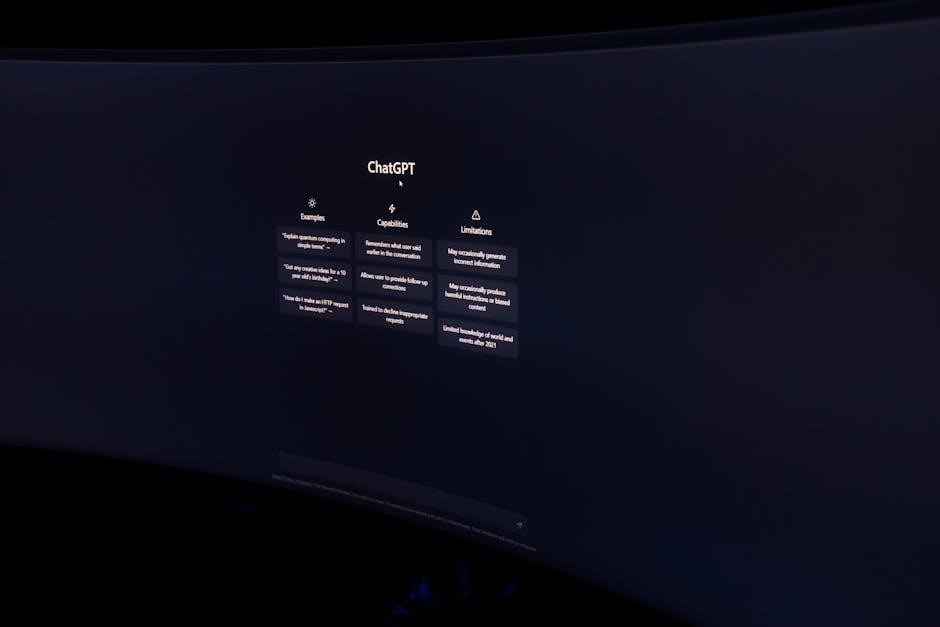
Despite advancements, ChatGPT isn’t infallible. It operates based on patterns learned from data, lacking genuine understanding or common sense reasoning. Custom instructions enhance control, but cannot overcome fundamental limitations. Users should be aware of potential “hallucinations” – instances where ChatGPT confidently presents incorrect or fabricated information.
Prompt injection attacks, where malicious input manipulates the model’s behavior, remain a concern, highlighting the need for careful input validation. While conversation memory features improve context retention, ChatGPT’s memory isn’t perfect and can still lose track of details over extended interactions.
Furthermore, ChatGPT’s knowledge cutoff date means it lacks awareness of events occurring after that point. Effective use of custom instructions requires acknowledging these constraints and critically evaluating the generated outputs.

The Future of Custom Instructions
Integration with ChatGPT CLI and the Store, alongside improved conversation memory, promises even deeper personalization and control, shaping a more intuitive AI experience for all users.
Integration with ChatGPT CLI and other LLMs
The emergence of ChatGPT CLI signifies a pivotal shift towards greater user control and flexibility. This command-line interface, supporting multiple LLMs like OpenAI, Azure, Perplexity, and LLaMA, allows for streamlined interaction and automation. Imagine applying your meticulously crafted custom instructions not just within the standard ChatGPT interface, but across a diverse range of language models through a single, unified platform.
This integration unlocks powerful possibilities for developers and advanced users. Custom instructions, previously confined to the ChatGPT ecosystem, can now be leveraged to tailor responses from various LLMs, ensuring consistency and personalized outputs regardless of the underlying model. Furthermore, the CLI’s streaming and interactive chat features enhance the usability of these customized experiences. As the landscape of LLMs continues to expand, the ability to seamlessly apply custom instructions across different platforms will become increasingly crucial for maximizing their potential.
The Impact of Conversation Memory Features
OpenAI’s introduction of conversation memory represents a significant leap forward in ChatGPT’s capabilities, profoundly impacting how custom instructions function. Previously, custom instructions provided a foundational context, but each interaction was largely independent. Now, with enhanced memory, ChatGPT can retain information from previous turns in the conversation, dynamically adjusting its responses based on evolving context.
This synergy between custom instructions and conversation memory creates a more nuanced and personalized AI experience. Instructions can establish long-term preferences and guidelines, while the conversation memory allows ChatGPT to adapt those instructions to the specific flow of the dialogue. For example, a preferred writing style defined in custom instructions can be consistently applied, even as the topic shifts throughout the conversation. This results in a more coherent and engaging interaction, blurring the lines between a generic chatbot and a truly personalized assistant;
The Role of the ChatGPT Store in Customization
The launch of the ChatGPT Store marks a pivotal moment for customization, transforming ChatGPT from a standalone tool into a platform for shared intelligence. This marketplace allows creators to develop and distribute specialized versions of ChatGPT, often built upon carefully crafted custom instructions. Users can now access pre-built “GPTs” tailored to specific tasks, eliminating the need to manually configure complex instructions.
This democratization of customization empowers both experts and novices. Developers can monetize their expertise by creating and selling GPTs, while users benefit from a wider range of specialized AI assistants. The Store fosters a collaborative ecosystem where best practices for custom instructions are shared and refined. Effectively, the ChatGPT Store amplifies the power of custom instructions, making advanced AI personalization accessible to a broader audience and accelerating innovation in the field.
Leave a Reply